
Raw evidence stays private first
Screenshots, crawl output, notes, and draft findings are reviewed before anything becomes public-facing.
Work evidence
QuickFix Creative publishes work through reviewed evidence: screenshots, public crawl notes, implementation context, and claims that can be backed up.
The work route is designed as a proof ledger. Raw evidence is captured and reviewed before it becomes public-facing material.
Screenshots, crawl output, notes, and draft findings are reviewed before anything becomes public-facing.
A project note must point back to a screenshot, crawl finding, implementation detail, or reviewed client-approved context.
Published work should show what changed, why it mattered, and what evidence supports the decision.
The workflow is intentionally plain: capture the evidence, find the friction, document what changed, and publish only what can be supported.
01
Collect desktop, tablet, and mobile screenshots plus public crawl data where appropriate.
02
Check first-screen clarity, CTA hierarchy, contact paths, trust signals, and mobile flow.
03
Record the friction, supporting evidence, recommended fix, and public-safe wording.
04
Show only reviewed screenshots, concise context, and claims that can be backed up.
These screenshots are public-safe because they document the QuickFix Creative preview itself. They prove the evidence system exists; they do not claim client outcomes.
The deployed work route now presents the evidence standards, proof workflow, raw-reference review states, and before/after method.
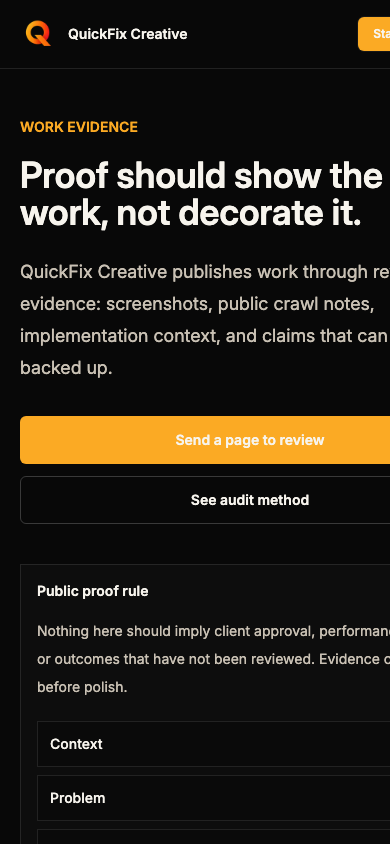
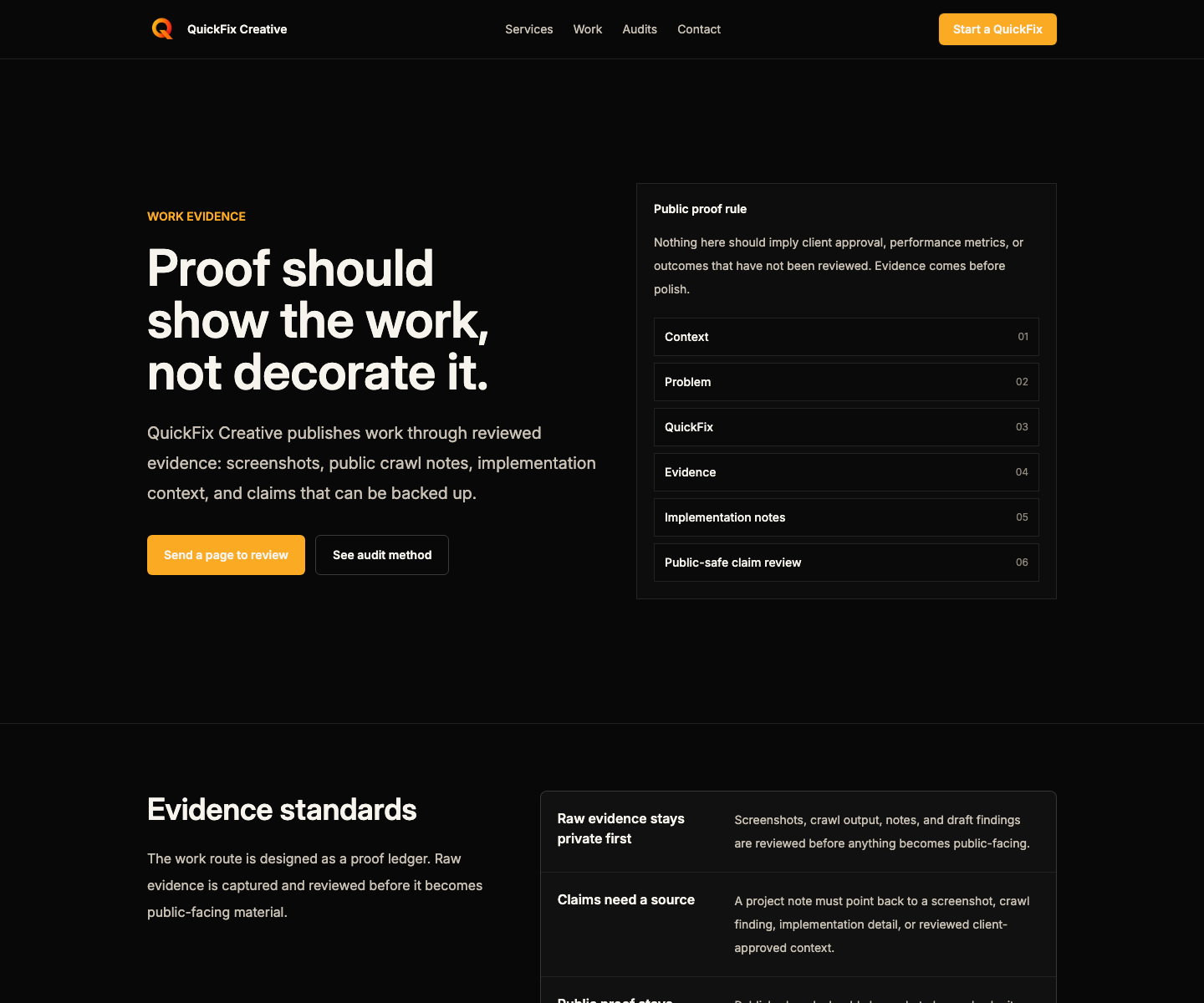
Source: Railway preview screenshots and crawl file: evidence/crawls/audits/2026-05-26-qfc-work-railway.md
The deployed audit route shows the issue, evidence, severity, and fix-path structure used to keep findings practical.
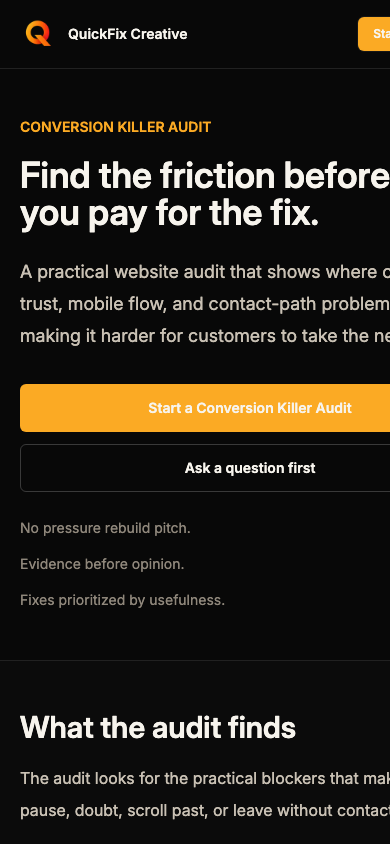
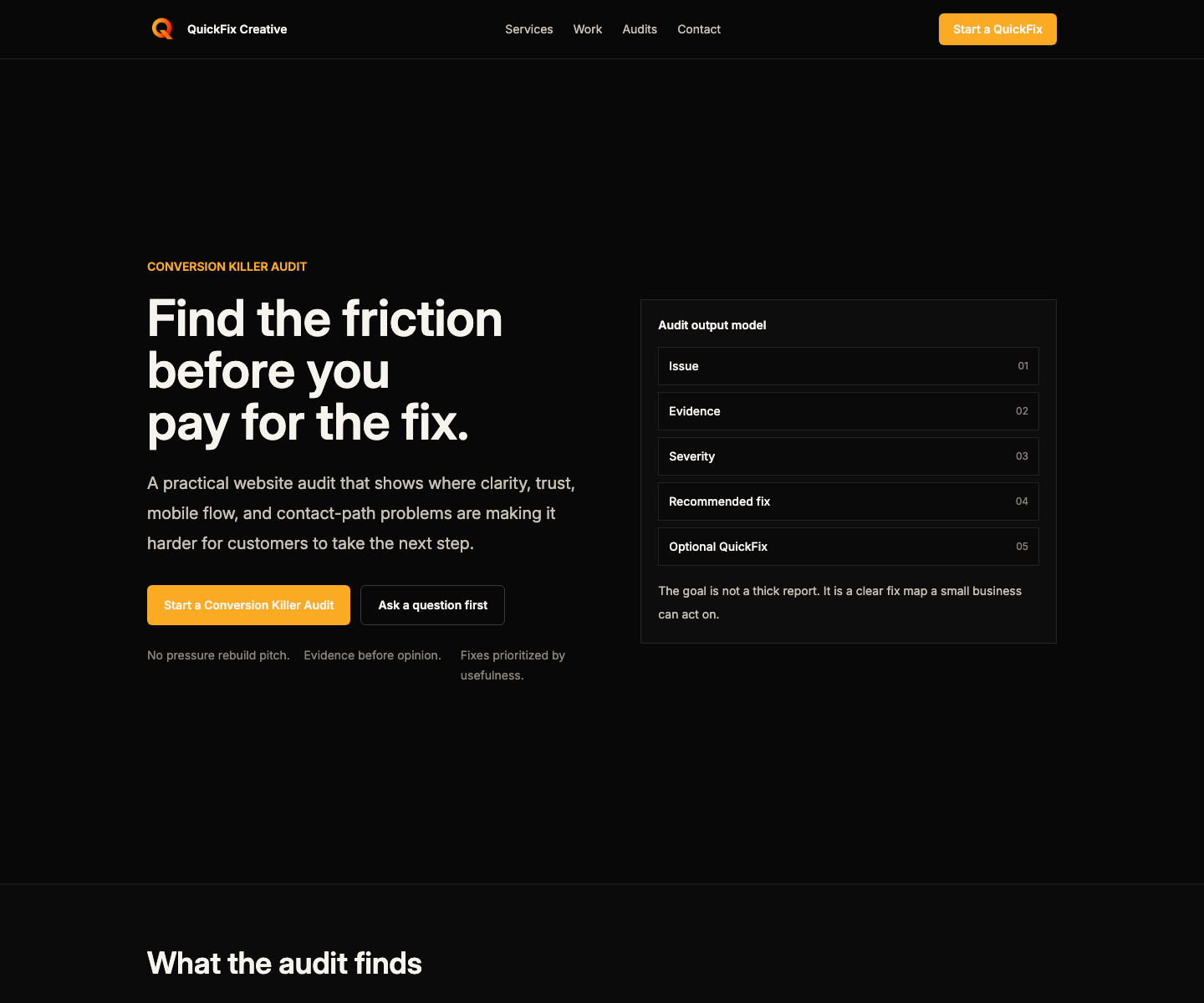
Source: Railway preview screenshots and crawl file: evidence/crawls/audits/2026-05-26-qfc-audits-railway.md
Public statements are limited to what the captured evidence can actually support.
The work and audit routes have screenshots captured at mobile, tablet, and desktop widths.
Source: evidence/screenshots/public-safe/mobile, evidence/screenshots/public-safe/tablet, and evidence/screenshots/public-safe/desktop
The deployed /work and /audits route content was extracted from the Railway preview for review.
Source: evidence/crawls/audits/2026-05-26-qfc-work-railway.md and evidence/crawls/audits/2026-05-26-qfc-audits-railway.md
Public reference URLs have raw screenshots and crawl files, but no outcomes, testimonials, or client approval are published from them.
Source: evidence/screenshots/raw and evidence/crawls/portfolio
The external reference review now separates approved observable UX patterns from held or rejected outcome claims.
Source: Phase 9 external reference review and evidence/crawls/portfolio
These entries document implementation work that has a clear artifact trail. They stay narrow on purpose: what existed, what changed, why it mattered, and what evidence supports it.
What existed
The /work route at commit 50c3299 was a single shell page describing future evidence.
Issue identified
The route stated the evidence policy, but it did not yet show captured proof, reviewed claims, or an operational evidence flow.
QuickFix
Added evidence standards, public-safe screenshots, raw-reference capture states, a claim ledger, and before/after implementation comparisons.
Why it matters
A visitor can now see how QuickFix Creative handles proof before being asked to trust portfolio claims.
Evidence
Claim boundary
This proves the evidence system exists. It does not claim client results, conversion lift, or approval from referenced projects.
What existed
The /audits route explained the Conversion Killer Audit method and evidence recording structure.
Issue identified
The route needed a public-safe way to show that the audit system itself had been captured and reviewed.
QuickFix
Added a current audit-route evidence ledger that maps public claims to the captured /audits crawl and Railway screenshots.
Why it matters
The audit offer now demonstrates its own discipline: issues need evidence, severity, and a practical fix path.
Evidence
Claim boundary
No Lighthouse scores, performance claims, conversion improvements, or client outcomes are published.
What existed
Four public reference URLs were listed as queued for evidence review.
Issue identified
Listing URLs without captured artifacts risks turning portfolio structure into unsupported proof.
QuickFix
Captured mobile and desktop screenshots plus crawl markdown for each reference URL, then kept them marked raw-captured until review.
Why it matters
The workflow shows operational discipline: evidence can exist without becoming a public claim too early.
Evidence
Claim boundary
These are not client case studies yet. No testimonials, outcomes, client approval, or performance claims are published.
What existed
Four external reference pages had raw crawls and local raw screenshots captured for review.
Issue identified
Raw evidence can accidentally look like client proof if the approval state and claim boundary are not explicit.
QuickFix
Reviewed each reference, promoted only direct observations, and recorded rejected or held claims separately from approved notes.
Why it matters
The work route can show evidence discipline without implying client approval, ownership, metrics, or outcomes.
Evidence
Claim boundary
This is a public-safe review workflow entry. It does not claim client approval, QuickFix ownership, before/after results, or measurable business impact.
The public case-study system records what can be said now and what stays held until better evidence exists.
QuickFix Creative has public-safe screenshots and crawl evidence for its own /work and /audits routes.
Source: Phase 7 screenshot and crawl artifacts.
The /work route evolved from a shell page into an evidence ledger with claim boundaries and public-safe screenshots.
Source: Git commit 50c3299, current route source, and /work crawl.
The reference projects produced measurable conversion, performance, revenue, or trust outcomes.
Source: No reviewed metric artifact or approved client outcome exists.
The reference projects are client-approved public case studies.
Source: Raw screenshots and crawls exist, but approval context is not recorded.
External reference pages can support narrow observations about visible UX, CTA, trust, and contact-path structure.
Source: Phase 9 review promoted only direct observations with explicit claim boundaries.
These are observations from public pages, not client case studies. Each note is limited to what the crawl and screenshots can directly support.
The captured page presents the emergency glass repair offer, direct phone/photo quote paths, and local trust signals in the first-screen and crawl evidence.
Source: Readable mobile/desktop raw screenshots plus evidence/crawls/portfolio/2026-05-26-ref-truview-glass.md. No client approval, ownership, outcomes, review authenticity, or performance claims are made.
The captured page makes the venue name, opening time, address, taplist path, and directions path visible in the first-screen and crawl evidence.
Source: Readable mobile/desktop raw screenshots plus evidence/crawls/portfolio/2026-05-26-ref-golden-pour.md. No traffic, booking, sales, ownership, or client approval claims are made.
The captured page uses a calculator-first flow, provider comparison path, trade-specific entry points, and visible verification/ABN signals.
Source: Readable mobile/desktop raw screenshots plus evidence/crawls/portfolio/2026-05-26-ref-tradiepayau.md. Crawl-visible data issues remain internal review notes; no data accuracy, revenue, affiliate, or conversion claims are made.
The crawl captures counselling credentials, Medicare rebate information, service categories, and contact-oriented site structure, but the raw screenshots captured only a loading state.
Source: evidence/crawls/portfolio/2026-05-26-ref-celia-dunsmore.md plus loading-state raw screenshots. Not promoted as visual public proof until a readable screenshot is captured and reviewed.
The review separates what can be said now from claims that stay held or rejected until better evidence exists.
It is public-safe to say the external reference pages were reviewed for observable UX, trust, CTA, and contact-path patterns.
Source: Phase 9 raw screenshot and crawl review.
TruView Glass, Golden Pour, and TradiePayAU have readable raw screenshot evidence plus crawl files supporting narrow observational notes.
Source: Local raw screenshot review and evidence/crawls/portfolio artifacts.
Celia Dunsmore Counselling can be used as visual public proof.
Source: The crawl has useful content, but both raw screenshots show a loading state.
Any external reference produced measurable conversion, revenue, performance, enquiry, or trust outcomes.
Source: No reviewed metric artifact exists.
External references are client-approved QuickFix Creative case studies.
Source: No approval context is recorded.
Screenshots and crawl notes now exist for each reference URL. Reviewed observations can be public-safe, but outcomes, ownership, testimonials, and client approval remain unclaimed.
Mobile and desktop screenshots plus crawl markdown captured. Pending reviewed case-study context.
Raw source: evidence/crawls/portfolio/2026-05-26-ref-truview-glass.md
Mobile and desktop screenshots plus crawl markdown captured. Pending reviewed case-study context.
Raw source: evidence/crawls/portfolio/2026-05-26-ref-celia-dunsmore.md
Mobile and desktop screenshots plus crawl markdown captured. Pending reviewed case-study context.
Raw source: evidence/crawls/portfolio/2026-05-26-ref-tradiepayau.md
Mobile and desktop screenshots plus crawl markdown captured. Pending reviewed case-study context.
Raw source: evidence/crawls/portfolio/2026-05-26-ref-golden-pour.md
The comparison is about operational maturity: what changed, which artifact supports it, and what can now be safely said.
Before
The /work route at commit 50c3299 was a single shell page describing future evidence.
Evidence
Git source at 50c3299 plus the captured /work crawl from the Railway preview.
After
The deployed /work route now shows evidence standards, proof workflow, raw-capture states, and public-safe comparison rules.
Before
Reference projects were listed as pending review without captured artifacts.
Evidence
Mobile and desktop screenshots plus crawl markdown were captured for the four public reference URLs on 2026-05-26.
After
The projects can now be marked as raw captured while staying out of public proof claims until reviewed.
Before
The audit route explained evidence discipline mostly as a method.
Evidence
Railway screenshots at 390, 768, and 1440 widths plus the captured /audits crawl.
After
The audit method now has traceable route evidence without claiming client results or performance gains.